


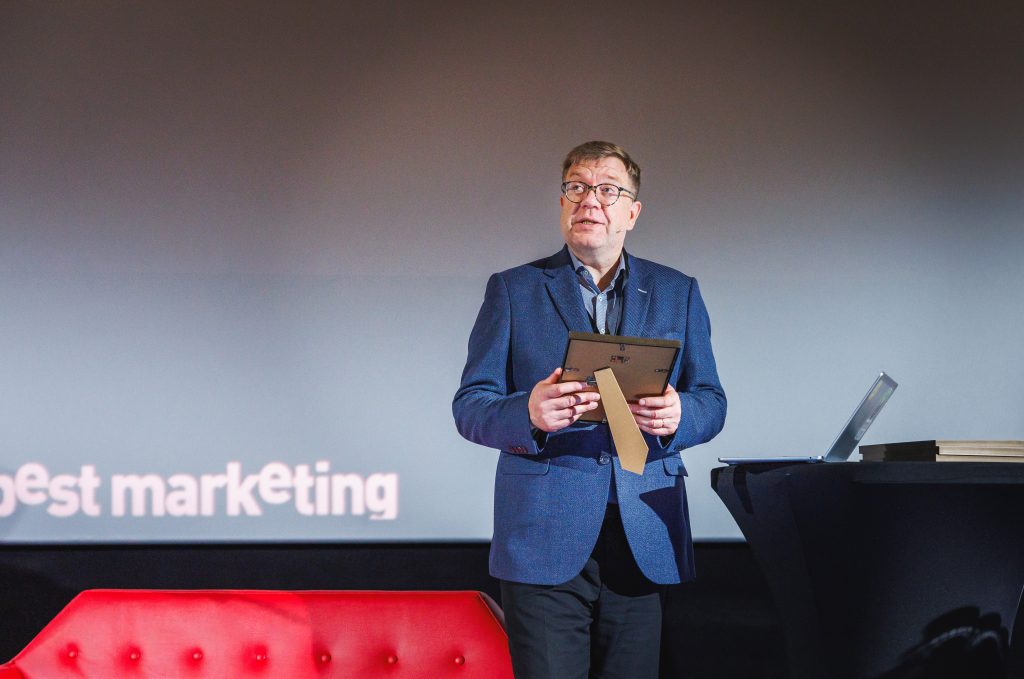
Before BalticBest, we interviewed nine Latvian and Lithuanian agency leaders about the key industry trends shaping 2026. Hando Sinisalu summed up the conversations around three themes: AI’s real limits, where growth actually comes from, and whether the industry still believes its own good news.
AI: useful, not creative
Almost nobody here thinks AI has replaced human judgment. Dovilė Dovidavičiūtė (Sons & Daughters): “our creatives still come up with better ideas than AI does.” Rimantas Stanevičius (Milk) values it mainly for speeding up decisions, not making them. Kristaps Deics (McCann Riga) is harsher, arguing a flood of AI content has made everything “boring,” and pushes clients back toward the handmade and visibly real. Jānis Kuprašovs (WKND) uses AI daily, but the brands that treat it carelessly, posting obviously synthetic content, are the ones getting burned. On AI research, Stanevičius treats synthetic focus groups as “one more informed input,” not gospel, and Deics is blunt that with AI, “you still don’t know if it’s true.”
Growth means leaving the Baltics
Paulius Senūta (Not Perfect Network) states it as survival: “Baltics equals death.” A third of his revenue is now international, including a major Hungarian telecom client. Andris Rubins (Magic) tells a similar story, now working globally for Swiss brand Felco after a pitch costing close to “a 50K investment.” Both say the real barrier isn’t money but unfamiliarity, Senūta calls it learning “the language of how to talk to London people.” Not everyone agrees: Ralfs Vilands (Rud Pedersen Group), in PR, sees his field as inherently local, since “language and meaning don’t translate” the way design does, and grows instead by absorbing adjacent services like advertising and social.
Flatter revenue, shorter horizons
Vilands describes clients who no longer plan ahead: “nobody is planning a year or even half a year ahead anymore.” Stanevičius says his agency’s revenue has been flat two years running, and voices a rare doubt about the whole industry’s mood, wondering if the good news is really “a kind of collective hallucination.” Kuprašovs, by contrast, reports a merely quieter summer, with budgets spread thinner across more brands.
Brands losing their edge
Kuprašovs and Deics converge here. Kuprašovs warns that generic influencer content erases distinctiveness, since rival brands now “use the same influencer and the same style of jokes.” Deics agrees influencers should stay minor, since a brand “has to remain the central voice,” and bets instead on what he calls anti-marketing: content that doesn’t look like advertising, citing Justin Bieber’s stripped-down halftime show as proof.
Culture and ownership
Aldis Ozoliņš (Guilty Ogilvy) frames the agency itself as protection against relying on one creative star, saying it’s “like insurance for continuity and quality.” Kristaps Silins (McCann Riga), whose group topped this year’s Baltic Agency ranking, credits sharing equity with seven new partners, now owning “less than half” of the firm he founded.
These nine conversations describe an industry reorganizing rather than shrinking: chasing clients abroad, automating routine work, and betting that a genuinely human idea is still the one thing AI can’t fake.
BalticBest 2026
SUBMIT YOUR WORK FOR FREE HERE!
(first make your own profile, log in and then click this link again)
If you have any problems, please contact [email protected] / +372 5028561 or [email protected] / +372 5144884
- Entry deadline (extended): 2 September
- Shortlist announcement: 9 September
- International jury evaluates shortlisted entries via live stream: 15–16 September
- Awards ceremony: 25 September (Baltic Brand Forum in Riga)
